One of the most common questions we hear from parents is deceptively simple: "Should my child join a football team or focus on training?" The answer, like most things in child development, isn't one-size-fits-all. What's right for a five-year-old is very different from what benefits a ten-year-old.
This confusion is understandable. The UK youth football landscape offers countless options: grassroots teams, development academies, school football, casual kickabouts, and structured training programs. Parents worry they'll make the wrong choice and somehow limit their child's potential or, worse, push them away from football altogether.
The good news? There's a natural progression that supports both skill development and long-term love for the game. Let's break down what children actually need at each stage of their football journey.
Ages 4-7: The Foundation Years
At this age, the answer is unequivocal: structured training sessions are vastly more beneficial than competitive team football.
Why Training Works Better
Children between four and seven are still developing fundamental movement skills. They're learning how to run efficiently, change direction, balance, and coordinate their bodies. Football-specific skills like dribbling, passing, and shooting are built on top of these foundational movement patterns.
Research on sport readiness in children shows that young children learn best through varied, playful practice with high ball contact time. At this age, standing in a fixed position waiting for the ball (as happens in matches) provides far less developmental benefit than constant engagement during training.
What Good Training Looks Like at This Age
Quality training sessions for 4-7 year olds should include:
- High ball contact time: Every child touching the ball hundreds of times per session, not just a few touches during a match
- Varied activities: Games and drills that develop different skills in engaging ways
- Movement variety: Running, jumping, turning, stopping, starting - building athletic foundations
- Positive reinforcement: Celebration of effort and improvement, not outcomes or comparisons
- Fun as the non-negotiable priority: If they're not smiling and asking to come back, something's wrong
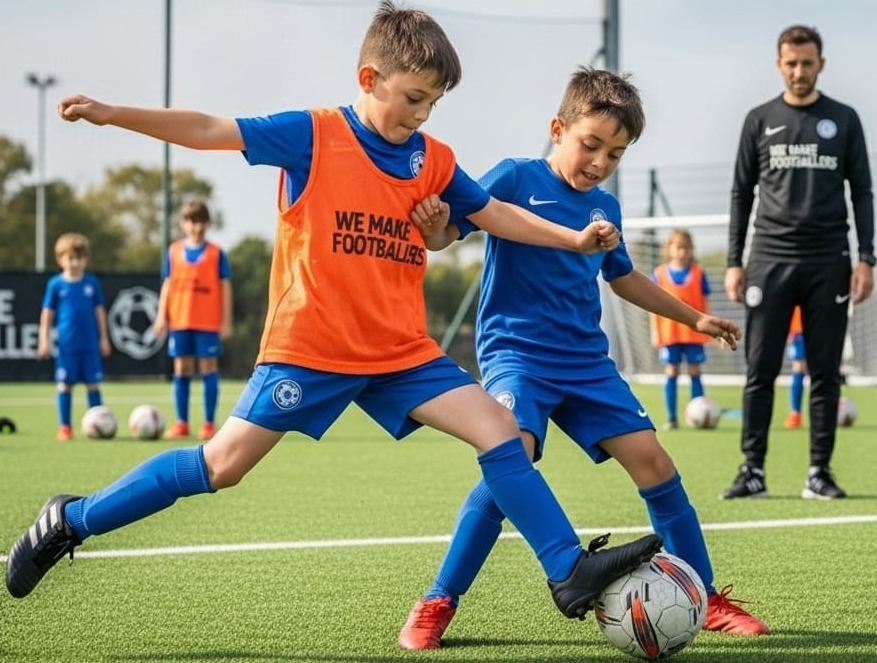
At We Make Footballers, our sessions for this age group are specifically designed around these principles. Children spend the entire session engaged, moving, and touching the ball, rather than standing in positions or waiting for their turn.
The Team Football Trap at This Age
When very young children play competitive team football too early, several problems emerge:
Parents on the sideline shouting conflicting instructions create anxiety rather than learning. Children standing in positions they don't understand, touching the ball only a handful of times during an entire match. Early comparisons between "better" and "worse" players that can damage confidence for years to come.
The FA recognizes these issues. Their youth football guidance emphasizes developmentally appropriate formats that prioritize engagement and development over competition for younger age groups.
Verdict for Ages 4-7: Prioritize structured training that maximizes ball contact and movement. Casual kickabouts with friends in the garden are wonderful. Organized team football with leagues, positions, and pressure? That should wait.
Ages 8-10: The Transition Phase
This is where the picture becomes more nuanced. Children in this age range can begin to benefit from both training and team football, but the balance matters enormously.
Why Both Start to Matter
By age eight, most children have developed sufficient physical coordination and cognitive ability to understand basic team concepts. Playing in matches helps them learn decision-making, spatial awareness, and how to apply skills under mild pressure.
However, they still need dedicated training time - arguably more than they need match play. A child might take only 10-20 touches during a 60-minute match, whereas they could take 500+ touches in a well-structured training session.
This is the age where technical skills are most rapidly developed. Research shows that the technical foundation built before age twelve largely determines a player's long-term potential and enjoyment of the game.
The Ideal Balance
For children aged 8-10, we recommend:
- 2-3 training sessions per week focused on technical development
- 1 match per week maximum to apply skills in game situations
- Unstructured play whenever possible (garden kickabouts, playground football)
This ratio ensures children continue developing their technical foundation while experiencing the joy and social connection of team play.
Warning Signs of Imbalance
Watch for these red flags that suggest your child's football schedule isn't serving them well:
Too much team focus, not enough training:
- Technical skills plateauing despite regular play
- Frustration during matches because they can't execute what they want to do
- Comparing themselves negatively to more technically skilled teammates
- Anxiety before matches or reluctance to try new skills
Too little football overall:
- Losing interest in the sport
- Lacking confidence with the ball
- Missing out on the social benefits of being part of a team
What About Academy Opportunities?
If your child receives an academy opportunity during this age range, parents often wonder whether they should stop everything else. The answer depends entirely on the specific academy and your child's experience.
Many children in academy systems also benefit from supplementary training programs that provide additional technical work outside the academy's more tactical focus. Some academies encourage this, others discourage it - you'll need to assess what works for your child.
The key questions aren't "academy or not?" but rather:
- Is my child still enjoying football?
- Are they continuing to develop technically?
- Is the environment supportive and age-appropriate?
Verdict for Ages 8-10: Combine regular technical training (2-3 times weekly) with team football (once weekly). The training remains the foundation; team play provides context, application, and social connection.
Ages 11-12: Building on the Foundation
By age eleven, children who've built a strong technical foundation through consistent training are ready to apply those skills more intensively in team environments. Children who've primarily played matches without adequate training often start to plateau.
The Critical Window Closes
Here's an uncomfortable truth that every parent needs to understand: the technical skills developed before age twelve largely determine what's possible afterward.
Statistics on academy football success reveal that only 0.5% of players who enter academies at age 9-11 go on to sign professional contracts. This isn't necessarily because they lack talent - often, it's because they lack the technical foundation that makes higher-level football accessible and enjoyable.
Children who've spent ages 4-11 in quality technical training programs have options at age twelve. They can pursue competitive pathways with genuine capability, or play recreationally with the confidence and skill that makes football fun. Either way, they're equipped for success.
Children who've only played matches without structured technical development often hit a frustrating ceiling. They understand the game but lack the technical proficiency to execute at the level they're attempting.
For the Seriously Committed
Children showing genuine passion and developing capability at this age benefit from:
- Continued technical training 2-3 times weekly (technical skill development doesn't stop at age 11)
- Competitive team football with qualified coaching
- Exposure to different playing environments when possible
- Maintained focus on enjoyment - burnout risk increases significantly at this age
Even children in academy systems often supplement with technical training programs because academy sessions increasingly focus on tactical understanding rather than pure skill development.
For the Recreational Player
There's absolutely nothing wrong with an eleven or twelve-year-old who wants to play football once or twice weekly while pursuing other interests. In fact, this balanced approach often produces happier, more well-rounded individuals who maintain their love for football throughout their lives.
Verdict for Ages 11-12: The foundation built in earlier years determines what's possible now. Continue prioritizing technical development alongside team football, regardless of competitive level.
The Foundation Question: Where Does Development Really Happen?
Here's what decades of youth football research conclusively demonstrates: technical skills developed before age twelve determine a player's long-term trajectory.
Children who spend ages 4-11 primarily playing matches without adequate training time often plateau in their early teens. They may love football, but they become frustrated by their inability to execute what they see in their minds.
Conversely, children who build a strong technical foundation through quality training have choices. They can pursue competitive pathways, play recreationally, or simply enjoy kickabouts with friends - but in all cases, they have the skills that make football genuinely enjoyable rather than an exercise in frustration.
This is precisely why We Make Footballers exists and why we focus exclusively on ages 4-12.
The We Make Footballers Difference
We've designed our programs specifically to provide the technical foundation that every child needs, regardless of where their football journey ultimately leads:
For younger children (4-7): We offer the structured, playful training they desperately need before competitive team football becomes appropriate. Every session maximizes ball contact, movement variety, and fun.
For children aged 8-12: We provide the focused technical development that complements team football. Players who train with us consistently demonstrate better touch, improved decision-making, and greater confidence on the ball - advantages their team coaches invariably notice.
For all ages: We create an environment where improvement is celebrated, effort is valued, and every child develops genuine confidence with the ball. Children who've lost confidence at competitive clubs often rediscover their love for football within weeks of joining us.
How to Make the Right Choice for Your Child
Rather than asking "training or teams?" ask these questions:
1. What age is my child?
-
Ages 4-7: Training only (plus casual play)
- Ages 8-10: Training 2-3 times, team football once
- Ages 11-12: Maintain training alongside team commitments
2. Is my child developing technically?
Can they do more with a ball now than six months ago? If not, they need more training time, regardless of how much they're playing.
3. Is my child still enjoying football?
If the answer is no, everything else is irrelevant. Make immediate changes.
4. Does their current setup actually maximize ball contact?
Count how many times your child touches the ball in their various football activities. Training should provide hundreds of touches per session. Matches might provide 10-20. Adjust accordingly.
5. What does my child want?
Their voice matters most. Some children thrive in competitive environments, others prefer less pressure. Both paths are valid when supported by proper technical development.
The Bottom Line
Ages 4-7: Training-focused with no competitive team football
Ages 8-10: Regular training (2-3 weekly) plus team football (once weekly)
Ages 11-12: Maintain technical training alongside increasing team commitments
At every age within this critical development window, quality technical training provides the foundation. Team football offers application and social experience. Together, when balanced appropriately, they create confident, capable players who have both the skills and the love for football that lasts a lifetime.
The choices you make during ages 4-12 determine everything that comes after. Choose wisely.
Book a free trial session at your nearest We Make Footballers location and give your child the technical foundation that opens every door.
Because the right training today creates confident players tomorrow.